Lo Shu Grid Numerology: The Ancient Chinese Number Square
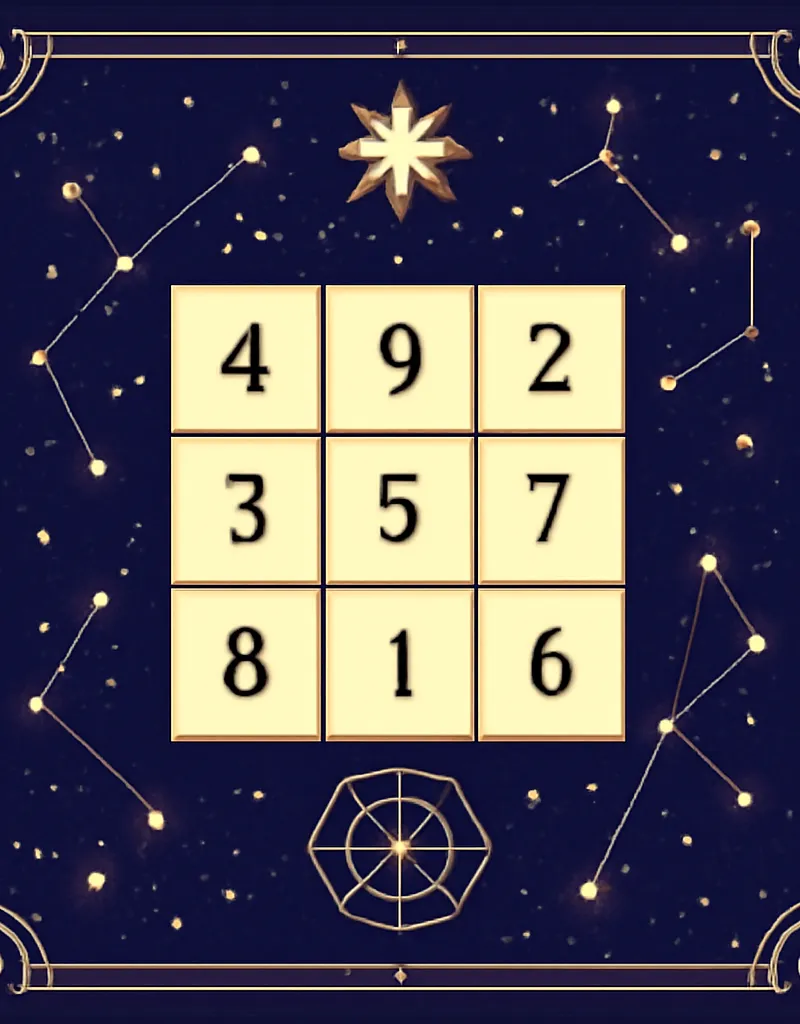
Lo Shu Grid Numerology: The Ancient Chinese Number Square Explained
Ever wondered if an ancient Chinese number square could unlock secrets about your personality and life path? What if a simple grid, originating from a mystical turtle's back, held keys to understanding your strengths, weaknesses, and even your destiny? That's the magic of Lo Shu Grid Numerology (लॉ शू ग्रिड संख्या विज्ञान), a fascinating system that has guided people for millennia. It’s not just about numbers; it’s about the energetic patterns they form, reflecting your inner self and potential.TL;DR: Lo Shu Grid in a Nutshell
The Lo Shu Grid is an ancient Chinese 3x3 magic square where numbers 1-9 are arranged such that every row, column, and diagonal sums to 15. In numerology, it's used to analyze an individual's personality, talents, and challenges by mapping the digits of their birth date onto the grid. Missing numbers indicate areas for growth (Arrows of Weakness), while repeated numbers or complete lines (Planes) reveal innate strengths (Arrows of Strength). It’s a powerful tool for self-discovery and practical guidance in daily life, helping you understand your inherent numerical blueprint.
What Exactly is the Lo Shu Grid?
At its core, the Lo Shu Grid is a 3x3 magic square. What makes it "magic"? Every row, every column, and both main diagonals add up to the number 15. Take a look:| 4 | 9 | 2 |
|---|---|---|
| 3 | 5 | 7 |
| 8 | 1 | 6 |
A Dive into its Mystical Origins: The Legend of Yu
The story of the Lo Shu Grid is as enchanting as the grid itself. Legend has it that around 2200 BC, during the reign of Emperor Yu the Great, a devastating flood plagued ancient China. While Emperor Yu was working tirelessly to dig canals to control the floodwaters, a divine turtle emerged from the Luo River. On its back was a peculiar pattern of dots, arranged in a 3x3 square, with numbers represented by these dots. This pattern was the Lo Shu Grid. The arrangement of the dots was not random; it was a perfect magic square. Emperor Yu recognized its profound significance and used its principles to bring order and harmony to his kingdom, developing methods of flood control and even organizing society based on its balance. This ancient knowledge, passed down through generations, became a foundational concept in Chinese metaphysics, influencing everything from urban planning to personal destiny analysis. It’s one of the oldest known numerology systems, a testament to humanity's enduring fascination with the power of numbers.The Universal Language of Numbers: How Lo Shu Connects to Your Life
Numbers are more than just quantities; they are symbols imbued with specific energies and meanings. In Lo Shu Grid Numerology, each position and number within the grid tells a story about you. It's a snapshot of your innate tendencies, much like how different planets influence you in astrology.Understanding the Core Principles: Magic Squares and Energy Flow
The "magic" of the Lo Shu square isn't just a mathematical curiosity; it signifies balance and harmony. The sum of 15 (1+5=6) is considered auspicious in Chinese culture, representing good fortune and prosperity. When we map your birth date onto this grid, we're essentially seeing which of these fundamental energies are strong, weak, or completely missing in your unique energetic blueprint. Each number's position in the grid corresponds to a specific area of life and a specific element: * **Top Row (4, 9, 2):** Mental Plane (Wood, Fire, Earth) * **Middle Row (3, 5, 7):** Emotional Plane (Wood, Earth, Metal) * **Bottom Row (8, 1, 6):** Practical Plane (Earth, Water, Metal) This interplay of numbers, elements, and planes provides a comprehensive picture of your inner workings.The Significance of Each Number in the Grid (1-9)
Let's quickly go over what each number represents in the Lo Shu Grid. Think of these as archetypes, each bringing its own flavour to your personality.- Number 1 (Bottom Middle - Water): Represents the Self, Independence, Leadership, and Communication. It's the core of your being.
- Number 2 (Top Right - Earth): Symbolizes Intuition, Cooperation, Diplomacy, and Sensitivity. It's about partnerships and understanding.
- Number 3 (Middle Left - Wood): Governs Creativity, Expression, Imagination, and Optimism. The artistic and joyful side.
- Number 4 (Top Left - Wood): Signifies Practicality, Organization, Stability, and Hard Work. The builder and planner.
- Number 5 (Center - Earth): The Heart of the Grid. Represents Freedom, Adaptability, Change, and Adventure. It's the balancer.
- Number 6 (Bottom Right - Metal): Denotes Responsibility, Family, Home, and Service. The nurturer and protector.
- Number 7 (Middle Right - Metal): Associated with Spirituality, Analysis, Wisdom, and Solitude. The seeker of truth.
- Number 8 (Bottom Left - Earth): Represents Ambition, Material Success, Power, and Justice. The achiever.
- Number 9 (Top Middle - Fire): Symbolizes Humanity, Compassion, Ideals, and Enlightenment. The humanitarian.
Decoding Your Lo Shu Grid: A Step-by-Step Guide for Self-Discovery
Ready to find out your own unique Lo Shu Grid? It's surprisingly simple! All you need is your full birth date (DD-MM-YYYY).How to Calculate Your Birth Chart Grid
Unlike Chaldean or Pythagorean numerology which often reduces numbers, for the Lo Shu Grid, we use all individual digits of your birth date. This is one of the key distinctions among different numerology systems. Let's take an example: Suppose you were born on **15th August 1990**. 1. **List out all the digits:** 1, 5, 0, 8, 1, 9, 9, 0. 2. **Ignore zeros:** For the purpose of filling the grid, zeros are generally ignored as they don't occupy a square. So, our digits become: 1, 5, 8, 1, 9, 9. 3. **Count repetitions:** * Number 1: Appears twice (from 1 and 1990) * Number 5: Appears once (from 15) * Number 8: Appears once (from August) * Number 9: Appears twice (from 1990) * Numbers 2, 3, 4, 6, 7 are missing. This list of numbers is what you'll use to populate your grid.Filling the Grid: Where Do Your Numbers Go?
Now, let's create your personal Lo Shu Grid. Draw a simple 3x3 square. Place each number you found from your birth date into its corresponding cell in the grid. If a number appears multiple times, write it multiple times in its cell. If a number is missing from your birth date, leave that cell blank. Using our example, **15th August 1990**: * **Number 1:** Appears twice. Go to the '1' cell (Bottom Middle) and write '1, 1'. * **Number 5:** Appears once. Go to the '5' cell (Center) and write '5'. * **Number 8:** Appears once. Go to the '8' cell (Bottom Left) and write '8'. * **Number 9:** Appears twice. Go to the '9' cell (Top Middle) and write '9, 9'. * **Numbers 2, 3, 4, 6, 7:** Are missing. Their cells remain empty. Your grid for 15-Aug-1990 would look like this:| 4 (empty) | 9, 9 | 2 (empty) |
|---|---|---|
| 3 (empty) | 5 | 7 (empty) |
| 8 | 1, 1 | 6 (empty) |
Interpreting the Planes and Arrows: Personality Insights
Once your grid is filled, you'll look for two main things:- **Planes of Strength/Weakness:** Complete rows, columns, or diagonals.
- **Arrows of Strength/Weakness:** Gaps (missing numbers) or full lines.
The Power of Planes: Unveiling Your Strengths and Challenges
The Lo Shu Grid is organized into several "planes," which are essentially the horizontal, vertical, and diagonal lines. When you have all the numbers filling a particular plane, it indicates a strong, well-developed trait. If a plane has missing numbers, it points to an area that might need more attention or development.Horizontal Planes: Mental, Emotional, and Practical
These planes reflect how you process information, express feelings, and interact with the physical world.- Mental Plane (4-9-2): This top row represents intellect, reasoning, analysis, and creativity.
- Full Plane (e.g., born 29/04/19XX, 24/09/19XX): You possess a sharp mind, excellent memory, and strong analytical abilities. You might be a deep thinker, always seeking knowledge and understanding. Think of a brilliant software engineer or an academician.
- Missing Numbers: If you're missing numbers here (e.g., no 9), you might struggle with focus, have a short attention span, or find it hard to express complex thoughts clearly. This could mean you rely more on intuition than logic sometimes, or you need to consciously work on mental discipline.
- Emotional Plane (3-5-7): The middle row deals with feelings, intuition, spirituality, and sensitivity.
- Full Plane (e.g., born 03/05/197X, 07/03/195X): You are highly empathetic, intuitive, and often spiritually inclined. You connect easily with others' emotions and possess a deep inner wisdom. Many artists, counsellors, or spiritual leaders have a strong emotional plane.
- Missing Numbers: A lack of numbers here (e.g., no 3 or 7) could suggest difficulty in expressing emotions, feeling detached, or a tendency to be overly logical at the expense of feelings. This person might seem reserved or find it challenging to connect on a deeper emotional level.
- Practical Plane (8-1-6): This bottom row relates to action, material matters, organization, and a down-to-earth approach.
- Full Plane (e.g., born 16/08/19XX, 08/01/196X): You are practical, hardworking, and good with your hands. You thrive on routine, enjoy tangible results, and are excellent at managing resources. You might be a successful entrepreneur, a skilled craftsman, or someone who excels in operations.
- Missing Numbers: If this plane is incomplete (e.g., no 6 or 8), you might find it hard to organize, manage finances, or struggle with practical execution. You might be more of a dreamer than a doer, needing to cultivate discipline in daily tasks.
Vertical and Diagonal Planes: Will, Thought, and Action
These planes offer further insights into your drive, communication, and decision-making.- Thought Plane (4-3-8): This vertical line on the left (4-3-8) signifies your intellectual and creative thought processes.
- Full Plane: You're a brilliant conceptualizer, able to think deeply and articulate complex ideas. You can strategize and plan effectively.
- Missing Numbers: You might struggle with original thinking or find it hard to translate ideas into actionable plans.
- Will Plane (9-5-1): The central vertical line (9-5-1) reveals your determination, courage, and core identity.
- Full Plane: You possess strong willpower, resilience, and a clear sense of purpose. You are a natural leader who inspires others.
- Missing Numbers: This could indicate a lack of self-confidence, indecision, or difficulty in standing up for yourself. You might need to work on building inner strength.
- Action Plane (2-7-6): This vertical line on the right (2-7-6) shows how you execute plans and interact socially.
- Full Plane: You are efficient, organized, and good at completing tasks. You're also likely to be a good team player and communicator.
- Missing Numbers: You might be prone to procrastination, struggle with follow-through, or find it hard to delegate effectively.
- Golden Plane (4-5-6) & Silver Plane (2-5-8): The diagonals. These are also known as the Plane of Determination (4-5-6) and the Plane of Spirituality (2-5-8).
- Full Plane of Determination: You are highly determined, persistent, and can overcome obstacles with grit.
- Full Plane of Spirituality: You possess deep intuition, spiritual awareness, and a strong connection to higher realms.
- Missing Numbers: Indicate challenges in these specific areas, requiring conscious effort.
Arrows of Strength & Weakness: What Your Missing Numbers Reveal
Beyond the individual planes, the Lo Shu Grid also highlights "Arrows" – lines formed by either all present numbers (Arrows of Strength) or all missing numbers (Arrows of Weakness). These are powerful indicators of your inherent traits and areas needing development.Arrows of Strength: Natural Talents and Positive Traits
When you have a complete line of numbers, it forms an Arrow of Strength, signifying a strong, ingrained characteristic.- Arrow of Intellect (4-9-2): A powerful mental plane. You are bright, logical, and have an excellent memory. Great for professions requiring critical thinking.
- Arrow of Will (1-5-9): A strong core. You are determined, focused, and can overcome any obstacle. You have leadership qualities.
- Arrow of Action (3-5-7): The doer's line. You are energetic, practical, and good at getting things done. You enjoy physical activity and adventure.
- Arrow of Love & Family (6-1-8): (8-1-6) You are responsible, nurturing, and deeply committed to your family and community. You make a wonderful parent or caregiver.
- Arrow of Patience (4-5-6): You are patient, persistent, and methodical in your approach to life. You rarely give up.
- Arrow of Spirituality (2-5-8): You are intuitive, empathetic, and often have a strong connection to spiritual or mystical realms. You might be drawn to healing or humanitarian work.
Arrows of Weakness: Areas for Growth and Overcoming Challenges
Conversely, if you have a complete line of missing numbers, it forms an Arrow of Weakness. This isn't a "bad" thing; it simply highlights areas where you might face challenges or need to consciously develop yourself. It's an opportunity for growth!- Arrow of Indecision (1-2-3 missing): You might struggle to make decisions, lack confidence, or find it hard to assert yourself.
- Remedy: Work on self-esteem, practice making small decisions, and trust your intuition.
- Arrow of Frustration (4-5-6 missing): You might feel easily frustrated, impatient, or struggle with persistence.
- Remedy: Cultivate patience, break down tasks into smaller steps, and celebrate small victories.
- Arrow of Scepticism (7-8-9 missing): You might be overly analytical, cynical, or find it hard to trust others or the universe.
- Remedy: Practice gratitude, develop empathy, and engage in activities that foster faith and connection.
- Arrow of Laziness (1-4-7 missing): You might lack motivation, be prone to procrastination, or struggle with taking initiative.
- Remedy: Set clear goals, create routines, and find activities that energize you.
- Arrow of Sensitivity (2-5-8 missing): You might be overly sensitive, easily hurt, or struggle with emotional boundaries.
- Remedy: Practice self-care, develop emotional resilience, and learn to protect your energy.
- Arrow of Disorganization (3-6-9 missing): You might struggle with planning, organization, or keeping promises.
- Remedy: Develop organizational habits, use planners, and work on follow-through.
"Numbers are not just symbols; they are cosmic vibrations that reveal the blueprint of your soul. Understanding your Lo Shu Grid is like reading your soul's instruction manual."
Lo Shu Grid in Indian Context: Beyond the Chinese Origins
While the Lo Shu Grid has ancient Chinese roots, its principles of balance, elemental energies, and numerical significance resonate deeply with Indian philosophical traditions, particularly Vaastu Shastra and even aspects of Vedic Numerology. In India, we have always valued the wisdom of ancient numerology systems for guidance in life.How Lo Shu Complements Vedic Numerology
Both Lo Shu and Vedic Numerology acknowledge the profound impact of numbers on our lives. While Vedic Numerology (which focuses on your Psychic, Destiny, Name, and Kua numbers) offers a detailed individual analysis, the Lo Shu Grid provides a visual, grid-based overview of your strengths and weaknesses. Think of it this way: If Vedic Numerology gives you the deep dive into your core numbers and their planetary rulers, the Lo Shu Grid offers a clear map of your inherent personality patterns. It's like having two different, powerful lenses to view the same truth. For example, if your Vedic Numerology chart shows a strong influence of Jupiter (often associated with 3), and your Lo Shu Grid reveals a strong Emotional Plane (3-5-7), these insights would beautifully complement each other, confirming your creative and intuitive nature.For a deeper understanding of how these systems compare, you might find our article on Vedic Numerology vs Western: Complete Comparison particularly insightful. It helps demystify the nuances between different approaches.
Practical Applications for Indian Families and Businesses
In India, numbers are often considered for auspicious dates, names, and even house numbers. The Lo Shu Grid can be an excellent tool for:- Family Harmony: Understanding the missing numbers (Arrows of Weakness) in each family member's grid can foster empathy. For instance, if your spouse has an "Arrow of Indecision," you might offer more support rather than criticism, especially during festival preparations or important family decisions.
- Child Development: For parents, knowing your child's Lo Shu Grid can help you identify their natural talents early on. If your child has a strong Mental Plane, you might encourage academic pursuits. If they have an Arrow of Laziness, you know to gently guide them towards discipline and routine from a young age.
- Career Guidance: If a young graduate is confused about their path (common in India, isn't it?), their Lo Shu Grid can point towards suitable professions. A strong Practical Plane suggests engineering, business, or skilled trades, while a strong Emotional Plane might indicate arts, counselling, or teaching.
- Business Partnerships: Before forming a partnership, especially in a family business, comparing Lo Shu Grids can reveal complementary strengths and potential areas of conflict. For instance, one partner with a strong "Arrow of Action" can drive projects, while another with an "Arrow of Intellect" can handle strategy.
- Vaastu and Home Layout: While not a direct Vaastu tool, the principles of balance and energy flow in Lo Shu can inform your understanding of optimal home environments. For example, if your personal grid shows a lack of "6" (home, family), you might consciously create a more harmonious and nurturing space in your home to compensate.
Consider how different numerology systems, including Lo Shu, can offer a holistic view when combined with traditional Indian wisdom like Vaastu. The insights from Numerology vs Astrology: Which is More Accurate? also provide a great perspective on how these ancient sciences intersect.
Comparison: Lo Shu Grid vs. Other Numerology Systems
While the core idea of numbers holding meaning is universal, how different systems approach this varies significantly. Let's compare Lo Shu with some other popular numerology systems you might have heard of.| Feature | Lo Shu Grid Numerology (Chinese) | Vedic Numerology (Indian) | Western/Pythagorean Numerology |
|---|---|---|---|
| Origin | Ancient China (Legend of Yu) | Ancient India (Vedic texts, planetary influences) | Ancient Greece (Pythagoras) |
| Core Method | Mapping individual birth date digits onto a 3x3 magic square. Focus on presence/absence of numbers and complete lines. | Calculates Psychic (Birth), Destiny (Life Path), Name, and Kua numbers. Connects numbers to planets. | Reduces birth date and name to single digits (1-9, Master Numbers 11, 22, 33). Focus on Life Path, Expression, Soul Urge. |
| Numbers Used | Individual digits of DD-MM-YYYY (0s ignored). | Reduced sums of DD, DD+MM+YYYY, and letter values. | Reduced sums of DD, MM, YYYY, and full birth date. Name letters converted to numbers. |
| Key Insights | Personality patterns, strengths (Arrows of Strength), weaknesses (Arrows of Weakness), mental/emotional/practical planes. Visual representation. | Life purpose, inherent personality, karmic lessons, compatibility, lucky elements, planetary influences. | Life purpose, innate talents, personality traits, challenges, soul's desires, karmic debts. |
| Application | Self-understanding, identifying areas for growth, relationship dynamics, child development. | Predictive analysis, choosing auspicious names/dates, career guidance, spiritual growth. | Self-discovery, understanding life cycles, career suitability, relationship compatibility. |
Common Misconceptions and What Most Articles Get Wrong
With any ancient system, myths and misunderstandings can crop up. Let's clear the air about some common errors people make with Lo Shu Grid Numerology.It's Not Just About Luck: It's About Self-Awareness
Many people mistakenly think numerology, including Lo Shu, is solely about predicting good or bad luck. While it can highlight auspicious times or challenging periods, its primary purpose is self-awareness. The Lo Shu Grid doesn't *give* you luck; it shows you your inherent blueprint, empowering you to make conscious choices."The Lo Shu Grid is not a fortune-telling device; it's a mirror reflecting your inner potential and areas needing your conscious effort. It empowers you to create your own fortune."You can't change your birth date, but you can certainly change how you respond to the energies it presents. If you have an "Arrow of Indecision," knowing this isn't about being "unlucky"; it's an invitation to work on your confidence and decision-making skills.
The Myth of "Bad" Numbers: Every Number Has a Purpose
Another common misconception is that certain numbers are inherently "bad" or "unlucky." In Lo Shu, as in most numerology, there are no bad numbers. A missing number simply signifies an absence of that particular energy, creating an "Arrow of Weakness." This isn't a curse; it's a focal point for growth. For example, if you're missing the number 7 (spirituality, analysis), it doesn't mean you're doomed to be unspiritual. It means you might need to consciously cultivate introspection, spend time in nature, or explore spiritual practices to bring balance to that area of your life. Every number, and every absence of a number, serves a purpose in revealing your unique path of development. The goal is to balance and harmonize all the energies within your grid.Actionable Takeaways: Using Lo Shu Grid for Daily Life Improvement
So, now that you understand the basics of your Lo Shu Grid, how can you actually use this ancient wisdom today, in your modern Indian life? Here are some practical tips:Enhancing Relationships and Family Harmony
1. **Understand Your Loved Ones:** Calculate the Lo Shu Grids for your family members (spouse, children, parents). * **Example:** If your child has an "Arrow of Sensitivity" (2-5-8 missing), you'll understand why they might get easily upset or need extra emotional support, especially during stressful times like exams or family events. Instead of dismissing their feelings, you can provide a safe space for them to express themselves. 2. **Bridge Gaps:** If you and your spouse have complementary Arrows (e.g., one has a strong Mental Plane, the other a strong Emotional Plane), acknowledge and appreciate these differences. If you both have an "Arrow of Disorganization," make a conscious effort to create shared routines and responsibilities, perhaps using a family planner for household chores or festival preparations. 3. **Encourage Growth:** If a loved one has an Arrow of Weakness, gently encourage them to develop those traits. For someone with an "Arrow of Laziness," suggest engaging in sports or a hobby that requires discipline.Guiding Career Paths and Business Decisions
1. **Self-Assessment:** Look at your own Arrows of Strength. Are you leveraging them in your current job? * **Example:** If you have a strong "Arrow of Intellect" (4-9-2), but feel stuck in a routine, non-challenging role, it might be a sign to seek opportunities that utilize your analytical and problem-solving skills, perhaps a role in research, data analysis, or strategic planning. 2. **Team Building:** In a business setting, when hiring or forming teams, understanding the Lo Shu Grids of potential colleagues can help create a balanced team. A team needs a mix of "Action" people, "Intellectual" people, and "Emotional" people for holistic success. 3. **Addressing Weaknesses:** If your grid shows an "Arrow of Indecision" (1-2-3 missing), try making a conscious effort to improve your decision-making. This could mean seeking advice from trusted mentors, using pros-and-cons lists, or simply practicing making quicker choices in low-stakes situations. For business owners, this might mean delegating decision-making in areas where you are weak, or developing a clear decision-making framework. Remember, the Lo Shu Grid is a tool for self-empowerment. It highlights your inherent energies, but it's *you* who chooses how to harness them. Want your complete numerology blueprint? Get your personalized 30+ page report at NumeroVedic — analyzed from your name and birth date, delivered in minutes. Or try our free Life Path Calculator to start.FAQs about Lo Shu Grid Numerology
What is the significance of the number 15 in the Lo Shu Grid?
The number 15 (sum of every row, column, and diagonal) is highly significant. In Chinese culture, the number 15 is associated with balance, harmony, and good fortune. When reduced, 1+5 equals 6, which represents home, family, responsibility, and nurturing. This reinforces the idea that the grid brings stability and well-being to all aspects of life it represents.
Do zeros in my birth date count in Lo Shu Grid calculation?
No, generally, zeros are not placed in the Lo Shu Grid. They are typically ignored as they do not represent an active presence of a number in the grid. However, some advanced interpretations might consider the presence of many zeros as indicating a spiritual vacuum or areas of non-attachment, but for basic Lo Shu analysis, they are omitted.
Can Lo Shu Grid help with choosing a name for a baby or business?
While Lo Shu Grid primarily focuses on birth date analysis, understanding its principles can indirectly inform name choices. For instance, if a child's birth date creates many missing numbers in a certain plane (e.g., Emotional Plane), a name chosen through Chaldean or Pythagorean numerology that emphasizes those missing energies (e.g., a strong 3 or 7) could help balance their overall energetic blueprint. It's often used in conjunction with other numerology systems for name selection.
Is Lo Shu Grid related to Feng Shui?
Yes, absolutely! The Lo Shu Grid is a foundational concept in classical Feng Shui. Each square in the grid corresponds to a specific direction, element, and life area (e.g., wealth, health, relationships). Feng Shui practitioners use the Lo Shu Grid (often called the Ba Gua or Bagua) to analyze the energy flow of spaces, suggesting arrangements and enhancements to promote harmony and prosperity in homes and workplaces.
What if I have many repeated numbers in my Lo Shu Grid?
Repeated numbers signify a strong emphasis or an overexpression of that number's energy in your personality. For example, if you have multiple 1s, you might be extremely independent, a natural leader, but could also be prone to stubbornness or isolation. Multiple 9s could mean immense compassion and humanitarian ideals, but also a tendency to be overly emotional or idealistic. These repetitions highlight dominant traits that you need to learn to balance and integrate effectively.
NumeroVedic Research Team
Our editorial team studies classical Vedic numerology, Chaldean methods and the Lo Shu grid, and turns them into practical modern guidance. Every article is reviewed against traditional sources before publishing. Questions about your numbers? Get your personalized reading →
✦
Discover Your Numerology Blueprint
Get a personalized 30+ page report covering your life path, career, love, and year-ahead predictions.
Get Your Report — ₹499